How to Fix a Kitchen Drawer Bottom That's Sagging or Fallen Out
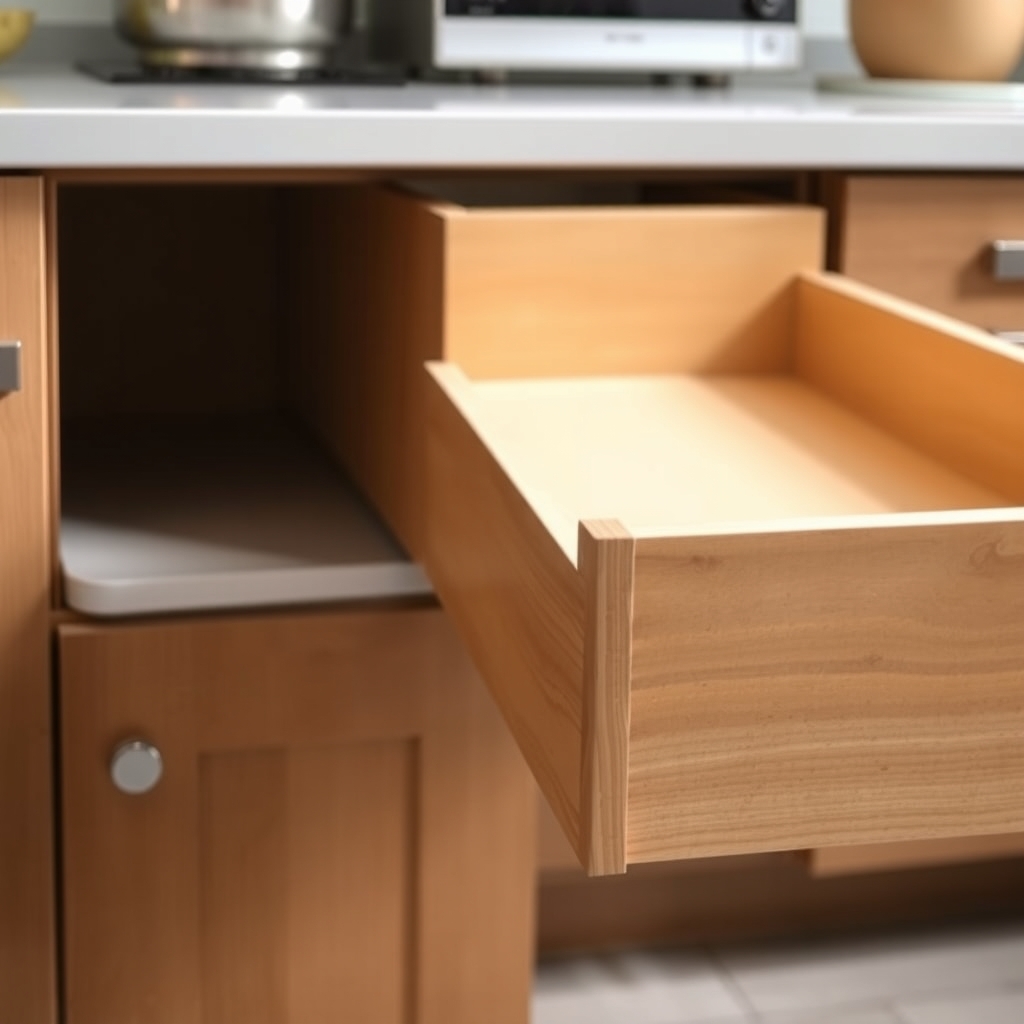
A drawer bottom is just thin hardboard in a groove. Re-seat and glue it today, or fit a new quarter-inch panel to end the sag for good.
By Jamilur Rahman Updated November 5, 2026 · 7 min read
- Time
- 30 min plus glue drying
- Cost
- Under $20
- Difficulty
- Medium
In this guide
Quick answer
To fix a kitchen drawer bottom that is sagging or has fallen out, slide the panel back into its groove, glue it in and add support under the middle. If the panel is warped, cracked or swollen, replace it with a new quarter-inch hardboard panel cut to fit. That is the fix that lasts, and the panel costs a few dollars.
Free fix vs. permanent fix
Re-seat, glue and prop up the old bottom
- Slide the panel back into the groove on all sides
- Run a bead of wood glue along the groove
- Glue a thin strip of scrap wood under the middle
- Move heavy pans to another drawer
How long it lasts: A few months on a light drawer. A warped or damp bottom sags again.
A new quarter-inch hardboard panel
The panel is the part that failed. Old bottoms warp, swell with damp or crack along the staples. A new flat panel, glued into the groove and pinned at the back, gives the drawer a strong base for another decade.
What to get: Quarter-inch hardboard panel
How long it lasts: Years. A flat panel in a clean groove stays flat unless it gets wet or overloaded.
As an Amazon Associate I earn from qualifying purchases.
What you'll need
-
Tape measure
To measure the groove and the old panel
You have it -
Old panel or cardboard
Use it as a pattern for the new cut
Free -
Short brad nails and a hammer
About 5/8 inch long, to pin the panel at the back
You have it - Illustration
Wood glue
For the groove and the support strip
- Our pick Illustration
Quarter-inch hardboard panel
Have the store cut it, or cut it yourself outdoors
- Illustration
Quarter-inch plywood panel
Stiffer, for heavy loads
Why it happens
Too much weight
Cast iron pans, cans and small appliances weigh a lot. A thin quarter-inch panel bows under that load and keeps the shape.
Moisture
A drawer near the sink or dishwasher soaks up damp. Hardboard and MDF swell, soften and lose strength.
Staples or nails that pulled out
Most bottoms are held by a few staples into the back panel. When those pull out, the panel slips out of its groove at the back and sags.
A groove that was never glued
Bottoms are often just slid into a groove with no glue. Years of use wear the groove edge, and the panel works loose.
Try this first (free)
Do these in order, starting with the simplest.
-
Empty the drawer and check the panel
Lift the drawer out of its slides and set it on a flat table. Press on the bottom. If it is flat and dry, re-seating may be enough. If it is warped, swollen or cracked, skip to the replacement steps.
-
Re-seat the panel and glue the groove
Tool used: Wood gluePush the panel back until it sits in the groove on the front and both sides. Run a thin bead of wood glue along the groove, press the panel in and wipe off the squeeze-out.
IllustrationCheck price on AmazonTool for this step
Wood glue · For the groove and the support strip
-
Pin it at the back
Tool used: Short brad nails and a hammerNail up through the panel into the lower edge of the back panel, with three or four short brads. Tap them in gently so they do not split the thin board.
-
Add a support strip
Glue a strip of scrap wood under the middle of the panel, running front to back. Keep it thin enough that the drawer still slides cleanly, and let the glue set overnight.
-
Measure for a replacement
Tool used: Old panel or cardboardIf the old panel is past saving, take it out and use it as a pattern. Measure the groove depth and the panel's width and length. Cut the new panel about 1/16 inch smaller than the groove-to-groove measurement, so it slides in.
-
Slide in the new panel
Tool used: Quarter-inch hardboard panelSlide the new quarter-inch panel in from the back, with its smooth side up. Glue the groove, nail it to the back panel and let it dry for a day. Sand the cut edges first. Hardboard makes very fine dust, so cut it outdoors and wear a dust mask.
IllustrationCheck price on AmazonTool for this step
Quarter-inch hardboard panel · Have the store cut it, or cut it yourself outdoors
When free fixes aren't enough
If the old panel is cracked, swollen or stained by water, glue will not bring its strength back. The edges soften first, then the groove stops holding it. A panel that has bowed for months has also taken a permanent bend. A new flat panel is the fix that lasts. If the drawer box itself is loose or the sides are cracked, fix the box before you fit the bottom.
Buy the fix
Still stuck after the free fixes? These are the products we would look at.
| Pick | Product | Fixes | Who it's for | Buy |
|---|---|---|---|---|
| Best pick | Quarter-inch hardboard panel | a bottom that is bowed, cracked, swollen or has slipped out of its groove | Most people with a broken or sagging bottom. It is cheap, it cuts easily and it matches what the drawer came with. | Check price |
| Budget pick | Wood glue and support strips | a bottom that is still flat but has slipped or started to sag | Someone whose panel is sound and who wants to keep it. | Check price |
| Upgrade pick | Quarter-inch plywood panel | a bottom that keeps sagging under heavy pots or tools | A pots-and-pans drawer, a tool drawer or a drawer near a sink. | Check price |
Quarter-inch hardboard panel
Fixes: a bottom that is bowed, cracked, swollen or has slipped out of its groove
Look for: True quarter-inch thickness, so it fits the groove; A smooth face on at least one side; Tempered hardboard if the drawer is near a sink; A sheet big enough to cover your drawer, with some spare.
- Who it's for
- Most people with a broken or sagging bottom. It is cheap, it cuts easily and it matches what the drawer came with.
- Honest downside
- Your groove is not quarter inch, or the drawer will hold very heavy items. Measure first, or choose plywood.
Wood glue and support strips
Fixes: a bottom that is still flat but has slipped or started to sag
Look for: Labeled for wood, with clamp time on the label; Dries clear or tan; Scrap strips about 3/4 inch wide.
- Who it's for
- Someone whose panel is sound and who wants to keep it.
- Honest downside
- The panel is warped, wet or cracked. Glue cannot undo that.
Quarter-inch plywood panel
Fixes: a bottom that keeps sagging under heavy pots or tools
Look for: True quarter-inch thickness; A smooth face without gaps or voids; A hardwood face such as birch.
- Who it's for
- A pots-and-pans drawer, a tool drawer or a drawer near a sink.
- Honest downside
- The drawer holds only light items. Hardboard costs less and does the job.
As an Amazon Associate I earn from qualifying purchases. We don't show prices because they change, so use the button to see today's price.
How we picked: How we picked: this page is based on cabinet and drawer repair guides, standard drawer construction, panel makers' size notes, and the problems and fixes people report in reviews. We do not test products by hand.
Quick measuring guide for a new bottom
- Groove width: slide a quarter-inch panel in. It should slide in easily but not rattle.
- Panel size: trace the old panel, or measure groove to groove and subtract about 1/16 inch.
- Square corners: check that the cut edges are square, or the panel will bind.
- Smooth side up: the smooth face goes up, where it will be cleaned.
What to skip
Cardboard patches and more staples
Cardboard softens and squashes under weight. Re-stapling a sagging panel puts the staples back in the same worn spots, so they pull out again. A thin plastic sheet flexes under a load and never gets stiff.
Frequently asked questions
How thick should a kitchen drawer bottom be?
How do I fix a drawer bottom that fell out?
Can I reuse a warped drawer bottom?
Why is the middle of my drawer bottom dipping?
Related problems
 Free fix inside
Small Spaces & Storage · Kitchen Drawer
Kitchen Drawer Front Came Off? Reattach It With the Right Brackets
Read the fix Free fix inside
Small Spaces & Storage · Kitchen Drawer
Kitchen Drawer Keeps Falling Off Track? Reset It or Replace the Slides
Read the fix Free fix inside
Small Spaces & Storage · Kitchen Drawer
Kitchen Drawer Not Sliding Smoothly? A Clean and Wax Often Fix It
Read the fix Free fix inside
Small Spaces & Storage · Drawer Organizing
Kitchen Drawer Too Deep? Stackable Trays That Use the Space
Read the fixAs an Amazon Associate I earn from qualifying purchases. Affiliate disclosure